
The Infra Play #119: The Satya point of view
It's no secret that in my view Satya Nadella has been the most effective cloud infrastructure software CEO in the last decade. This is largely due to the complete revamp of what was a general computing software company into a forward looking, cloud native enterprise on pace to achieve the largest competitive turnaround in corporate history (Azure catching up to and ultimately overtaking AWS).
His big bet on OpenAI was the lever that tipped Microsoft into this new direction and arguably kicked off the next industrial revolution. The trick with triggering such a turbulent transition period, however, is that there are no guarantees you get to keep winning. Graveyards are littered with great men who unleashed forces they couldn't control, and a lot is riding on how Satya can steer Microsoft through the transition.
The key takeaway
For tech sales and industry operators: One of the most difficult challenges in tech sales is predicting whether your company's current strategy is a competitive advantage or a slow-motion train wreck. Understanding how your CEO thinks is critical to this process. Satya's choices reveal a CEO hedging his bets, focusing on short term efficiency while setting up the fundamentals for a decade long rethinking of the Microsoft business, with emphasis on cementing Azure's leadership and developing a new application layer for enterprises. The underlying reasoning behind those decisions is tied to a shift in the software industry from low marginal cost economics to one where COGS matters enormously. The focus is on capturing business expansion across multiple areas while avoiding overly concentrated bets on OpenAI. This is a strong directional bet, assuming they can deliver their own models to power the long term application strategy layer. For other companies, the critical question is whether you're building wrapper products that commoditize overnight, or owning the substrate layer (the distribution, orchestration, and infrastructure that remains valuable regardless of which model wins).
For investors and founders: It's becoming increasingly clear that the moat isn't your current product, it's your ability to evolve business models while maintaining pricing power. Microsoft's software-driven capital efficiency improvements strongly suggest that knowledge intensity is their real competitive advantage. While the stock is unlikely to benefit in the short term from reduced investment in computing capacity, the staggered rollout of capital should pay off toward the end of the decade, as Azure's modular systems approach allows them to absorb rapid generational shifts in hardware. Still, there are risks in the more cautious approach being taken here, and it's not difficult to envision an alternative future where Satya has made a significant mistake by being too cautious, exposing Microsoft to a situation where they are behind, on both compute and model capability. He is playing a decade long game; if you are competing with him, make sure your runway supports the same horizon, or risk getting caught in the middle.
The Nadella effect
This article will provide commentary on the recent Dwarkesh Podcast interview with Satya. Dwarkesh has built a niche interviewing AI researchers, which doesn't make him the ideal fit to lead this conversation. Luckily for him, Dylan Patel from SemiAnalysis tagged along (and "lucky" is generous, given they are literal cousins living together in San Francisco). Dylan has built a business on scrutinizing large players and understanding what's happening behind the scenes, which sets up some of the provocative questions lobbed at Satya.
Dylan Patel: When you look at all the past technological transitions—whether it be railroads or the Internet or replaceable parts, industrialization, the cloud, all of these things—each revolution has gotten much faster in the time it goes from technology discovered to ramp and pervasiveness through the economy. Many folks who have been on Dwarkesh’s podcast believe this is the final technological revolution or transition, and that this time is very, very different.
At least so far in the markets, in three years we’ve already skyrocketed to hyperscalers doing $500 billion of capex next year, which is a scale that’s unmatched to prior revolutions in terms of speed. The end state seems to be quite different. Your framing of this seems quite different from what I would call the “AI bro” who’s like, “AGI is coming.” I’d like to understand that more.
Satya Nadella: I start with the excitement that I also feel for the idea that maybe after the Industrial Revolution this is the biggest thing. I start with that premise. But at the same time, I’m a little grounded in the fact that this is still early innings. We’ve built some very useful things, we’re seeing some great properties, these scaling laws seem to be working. I’m optimistic that they’ll continue to work. Some of it does require real science breakthroughs, but it’s also a lot of engineering and what have you.
That said, I also sort of take the view that even what has been happening in the last 70 years of computing has also been a march that has helped us move. I like one of the things that Raj Reddy has as a metaphor for what AI is. He’s a Turing Award winner at CMU. He had this, even pre-AGI. He had this metaphor for AI, it should either be a guardian angel or a cognitive amplifier. I love that. It’s a simple way to think about what this is. Ultimately, what is its human utility? It is going to be a cognitive amplifier and a guardian angel. If I view it that way, I view it as a tool.
But then you can also go very mystical about it and say this is more than a tool. It does all these things, which only humans did before so far. But that has been the case with many technologies in the past. Only humans did a lot of things, and then we had tools that did them.
Microsoft is probably the best example of a company that has optimized for implementing AI as a tool-first approach. While many companies have struggled with balancing implementation impact and the right way to use LLMs, every implementation within Microsoft has been straightforward, if not particularly exciting.
Dylan Patel: Microsoft historically has been perhaps the greatest software company, the largest software-as-a-service company. You’ve gone through a transition in the past where you used to sell Windows licenses and disks of Windows or Microsoft, and now you sell subscriptions to 365.
As we go from that transition to where your business is today, there’s also a transition going on after that. Software-as-a-service has incredibly low incremental cost per user. There’s a lot of R&D, there’s a lot of customer acquisition costs. This is sort of why, not Microsoft, but the SaaS companies have underperformed massively in the markets, because the COGS of AI is just so high, and that just completely breaks how these business models work.
How do you, as perhaps the greatest software-as-a-service company, transition Microsoft to this new age where COGS matters a lot and the incremental cost per user is different? Because right now you’re charging like, “Hey, it’s 20 bucks for Copilot.”
Satya Nadella: It’s a great question because in some sense with the business models themselves, the levers are going to remain similar. If you look at the menu of models starting from consumer all the way, there will be some ad unit, there will be some transaction, there will be some device gross margin for somebody who builds an AI device. There will be subscriptions, consumer and enterprise, and then there’ll be consumption. So I still think those are all the meters.
To your point, what is a subscription? Up to now, people like subscriptions because they can budget for them. They are essentially entitlements to some consumption rights that come encapsulated in a subscription. So I think that in some sense becomes a pricing decision. How much consumption you are entitled to is, if you look at all the coding subscriptions, kind of what they are, right? Then you have the pro tier, the standard tier, and what have you. So I think that’s how the pricing and the margin structures will get tiered.
The interesting thing is that at Microsoft, the good news for us is we are in that business across all those meters. At a portfolio level, we pretty much have consumption, subscriptions, to all of the other consumer levers as well. I think time will tell which of these models make sense in what categories.
One thing on the SaaS side, since you brought it up, which I think a lot about. Take Office 365 or Microsoft 365. Having a low ARPU is great, because here’s an interesting thing. During the transition from server to cloud, one of the questions we used to ask ourselves is, “Oh my God, if all we did was just basically move the same users who were using our Office licenses and our Office servers at the time to the cloud, and we had COGS, this is going to not only shrink our margins but we’ll be fundamentally a less profitable company.”
Except what happened was the move to the cloud expanded the market like crazy. We sold a few servers in India, we didn’t sell much. Whereas in the cloud suddenly everybody in India also could afford fractionally buying servers, the IT cost. In fact, the biggest thing I had not realized, for example, was the amount of money people were spending buying storage underneath SharePoint. In fact, EMC’s biggest segment may have been storage servers for SharePoint. All that sort of dropped in the cloud because nobody had to go buy. In fact, it was working capital, meaning basically, it was cash flow out. So it expanded the market massively.
So this AI thing will be that. If you take coding, what we built with GitHub and VS Code over decades, suddenly the coding assistant is that big in one year. That I think is what’s going to happen as well, which is the market expands massively.
The key difference between Microsoft and many other large legacy players has been their approach to margins. The older and larger the company, the greater the focus on providing a "sustainable and stable" business for shareholders. This reduces incentives for risky plays or quick pivots in business models. Satya's perspective has been that if Microsoft can capture market expansion under a different business model than what they've historically excelled at, that's perfectly acceptable.

Source: SemiAnalysis
Dwarkesh Patel: There’s a question of, the market will expand, but will the parts of the revenue that touch Microsoft expand? Copilot is an example. If you look earlier this year, according to Dylan’s numbers, GitHub Copilot revenue was like $500 million or something like that and there were no close competitors. Whereas now you have Claude Code, Cursor, and Copilot with around similar revenue, around a billion. Codex is catching up around $700–800 million. So the question is, across all the surfaces that Microsoft has access to, what is the advantage that Microsoft’s equivalents of Copilot have?
Satya Nadella: By the way, I love this chart.
I love this chart for so many reasons. One is we’re still on the top. Second is all these companies that are listed here are all companies that have been born in the last four or five years. That to me is the best sign. You have new competitors, new existential problems. When you say, who’s it now? Claude’s going to kill you, Cursor is going to kill you, it’s not boreland. Thank God. That means we are in the right direction.
This is it. The fact that we went from nothing to this scale is the market expansion. This is like the cloud-like stuff. Fundamentally, this category of coding and AI is probably going to be one of the biggest categories. It is the software factory category. In fact, it may be bigger than knowledge work. I want to keep myself open-minded about it.
We’re going to have tough competition. That’s your point, which is a great one. But I’m glad we have parlayed what we had into this and now we have to compete. On the competing side, even in the last quarter we just finished, we did our quarterly announcement and I think we grew from 20 to 26 million subs. I feel good about our sub growth and where the direction of travel on that is.
But the more interesting thing that has happened is, guess where all the repos of all these other guys who are generating lots and lots of code go? They go to GitHub. GitHub is at an all-time high in terms of repo creation, PRs, everything. In some sense we want to keep that open, by the way. That means we want to have that. We don’t want to conflate that with our own growth. Interestingly enough, we are getting one developer joining GitHub a second or something, that is the stat, I think. And 80% of them just fall into some GitHub Copilot workflow, just because there are. By the way, many of these things will even use some of our coding code review agents, which are by default on, just because you can use it. We’ll have many, many structural shots at this. The thing that we’re also going to do is what we did with Git. The primitives of GitHub, starting with Git, to issues, to actions, these are powerful, lovely things because they kind of are all built around your repo. We want to extend that.
Last week at GitHub Universe, that’s kind of what we did. We said Agent HQ was the conceptual thing that we said we’re going to build out. This is where, for example, you have a thing called Mission Control. You go to Mission Control, and now I can fire off. Sometimes I describe it as the cable TV of all these AI agents because I’ll have, essentially packaged into one subscription, Codex, Claude, Cognition stuff, anyone’s agents, Grok, all of them will be there. So I get one package and then I can literally go issue a task and steer them so they’ll all be working in their independent branches. I can monitor them. I think that’s going to be one of the biggest places of innovation, because right now I want to be able to use multiple agents. I want to be able to then digest the output of the multiple agents. I want to be able to then keep a handle on my repo.
If there’s some kind of a heads-up display that needs to be built and then for me to quickly steer and triage what the coding agents have generated, that to me, between VS Code, GitHub, and all of these new primitives we’ll build as Mission Control with a control plane. Observability… Just think about everyone who is going to deploy all this. It will require a whole host of observability of what agent did what at what time to what code base. I feel that’s the opportunity.
At the end of the day your point is well taken, which is we better be competitive and innovate. If we don’t, we will get toppled. But I like the chart, at least as long as we’re on the top, even with competition.
Funnily enough, Satya applies the same model to the other side of the equation, the "VC high growth" mental model for new business expansion. What Dylan calls a structural weakness in capturing demand for agentic coding, Satya views as acceptable performance for a nascent category of business expansion.
Dylan Patel: The key point here is sort of that GitHub will keep growing regardless of whose coding agent wins. But that market only grows at say 10, 15, 20%, which is way above GDP. It’s a great compounder. But these AI coding agents have grown from say $500 million run rate at the end of last year—which was just GitHub Copilot—to now where the current run rate across GitHub Copilot, Claude Code, Cursor, Cognition, Windsurf, Replit, OpenAI Codex… That’s run rating at $5–6 billion now for the Q4 of this year. That’s 10x.
When you look at the TAM of software agents, is it the $2 trillion of wages you pay people, or is it something beyond that? Because every company in the world will now be able to develop software more? No question Microsoft takes a slice of that. But you’ve gone from near 100%, or certainly way above 50%, to sub-25% market share in just one year. What is the confidence that people can get that Microsoft will keep winning?
Satya Nadella: It goes back a little bit, Dylan, to that there’s no birthright here, that we should have any confidence other than to say we should go innovate. Knowing the lucky break we have, in some sense, is that this category is going to be a lot bigger than anything we had high share in. Let me say it that way. You could say we had high share in VS Code, we had high share in the repos with GitHub, and that was a good market. But the point is that even having a decent share in what is a much more expansive market…
You could say we had a high share in client-server server computing. We have much lower share than that in hyperscale. But is it a much bigger business? By orders of magnitude. So at least it’s existence proof that Microsoft has been okay even if our share position has not been as strong as it was, as long as the markets we are competing in are creating more value. And there are multiple winners. That’s the stuff.
But I take your point that ultimately it all means you have to get competitive. I watch that every quarter. That’s why I’m very optimistic about what we’re going to do with Agent HQ, turning GitHub into a place where all these agents come. As I said, we’ll have multiple shots on goal on there. It need not be… Some of these guys can succeed along with us, so it doesn’t need to be just one winner and one subscription.
More importantly, Microsoft can leverage other structural advantages to regain growth and positioning in their desired market. In the case of agentic coding, there are obvious benefits to owning the infrastructure and leveraging distribution through Azure's sales team to capture a larger share of the total addressable market. This doesn't need to be limited to a twelve month horizon, since they can play a longer game than many new entrants in the space.
Dylan Patel: Unpacking what you said, there’s two views of the world. One is that there are so many different models out there. Open source exists. There will be differences between the models that will drive some level of who wins and who doesn’t. But the scaffolding is what enables you to win.
The other view is that, actually, models are the key IP. And everyone’s in a tight race and there’s some, “Hey, I can use Anthropic or OpenAI.” You can see this in the revenue charts. OpenAI’s revenue started skyrocketing once they finally had a code model with similar capabilities to Anthropic, although in different ways.
There’s the view that the model companies are the ones that garner all the margin. Because if you look across this year, at least at Anthropic, their gross margins on inference went from well below 40% to north of 60% by the end of the year. The margins are expanding there despite more Chinese open source models than ever. OpenAI is competitive, Google is competitive, X/Grok is now competitive. All these companies are now competitive, and yet despite this, the margins have expanded at the model layer significantly. How do you think about that?
Satya Nadella: It’s a great question. Perhaps a few years ago people were saying, “Oh, I could just wrap a model and build a successful company.” That has probably gotten debunked just because of the model capabilities, and the tools used, in particular.
But the interesting thing is, when I look at Office 365, let’s take even this little thing we built called Excel Agent. It’s interesting. Excel Agent is not a UI-level wrapper. It’s actually a model that is in the middle tier. In this case, because we have all the IP from the GPT family, we are taking that and putting it into the core middle tier of the Office system to teach it what it means to natively understand Excel, everything in it. It’s not just, “Hey, I just have a pixel-level understanding.” I have a full understanding of all the native artifacts of Excel. Because if you think about it, if I’m going to give it some reasoning task, I need to even fix the reasoning mistakes I make. That means I need to not just see the pixels, I need to be able to see, “Oh, I got that formula wrong,” and I need to understand that.
To some degree, that’s all being done not at the UI wrapper level with some prompt, but it’s being done in the middle tier by teaching it all the tools of Excel. I’m giving it essentially a markdown to teach it the skills of what it means to be a sophisticated Excel user. It’s a weird thing that it goes back a little bit to the AI brain. You’re building not just Excel, business logic in its traditional sense. You’re taking the Excel business logic in the traditional sense and wrapping essentially a cognitive layer to it, using this model which knows how to use the tool. In some sense, Excel will come with an analyst bundled in and with all the tools used. That’s the type of stuff that will get built by everybody.
So even for the model companies, they’ll have to compete. If they price stuff high, guess what, if I’m a builder of a tool like this, I’ll substitute you. I may use you for a while. So as long as there’s competition… There’s always a winner-take-all thing. If there’s going to be one model that is better than everybody else with massive distance, yes, that’s a winner-take-all. But as long as there’s competition where there are multiple models, just like hyperscale competition, and there’s an open source check, there is enough room here to go build value on top of models.
At Microsoft, the way I look at it is that we are going to be in the hyperscale business, which will support multiple models. We will have access to OpenAI models for seven more years, which we will innovate on top of. Essentially, I think of ourselves as having a frontier-class model that we can use and innovate on with full flexibility. And we’ll build our own models with MAI. So we will always have a model level. And then we’ll build—whether it’s in security, whether it’s in knowledge work, whether it’s in coding, or in science—our own application scaffolding, which will be model-forward. It won’t be a wrapper on a model, but the model will be wrapped into the application.
This is probably one of the most difficult areas to navigate: "What is the right area to focus on?" It appears that Satya's choice from a software delivery perspective will be offering their own application layer to enterprise customers and relying on distribution to establish a foothold. The AI Excel example is interesting because of the high virality of Shortcut AI, a startup that has won attention and business with an AI native version of Excel. Satya not only wants to compete with these new entrants; he sees Microsoft as very well positioned to win against them.
Satya Nadella: No, no, don’t worry about the Excel integration. After all, Excel was built as a tool for analysts. Great. So whoever is this AI that is an analyst should have tools that they can use.
Dwarkesh Patel: They have the computer. Just the way a human can use a computer. That’s their tool.
Satya Nadella: The tool is the computer. So all I’m saying is that I’m building an analyst as essentially an AI agent, which happens to come with an a priori knowledge of how to use all of these analytical tools.
Dwarkesh Patel: Just to make sure we’re talking about the same thing, is it a thing that a human like me using Excel…
Satya Nadella: No, it’s completely autonomous. So we should now maybe lay out what I think the future of the company is. The future of the company would be the tools business in which I have a computer, I use Excel. In fact, in the future I’ll even have a Copilot, and that Copilot will also have agents. But it’s still me steering everything, and everything is coming back. That’s one world.
The second world is the company just literally provisions a computing resource for an AI agent, and that is working fully autonomously. That fully autonomous agent will have essentially an embodied set of those same tools that are available to it. So this AI tool that comes in also has not just a raw computer, because it’s going to be more token-efficient to use tools to get stuff done.
In fact, I kind of look at it and say that our business, which today is an end-user tools business, will become essentially an infrastructure business in support of agents doing work. It’s another way to think about it. In fact, all the stuff we built underneath M365 still is going to be very relevant. You need some place to store it, some place to do archival, some place to do discovery, some place to manage all of these activities, even if you’re an AI agent. It’s a new infrastructure.
Dwarkesh Patel: To make sure I understand, you’re saying theoretically a future AI that has actual computer use—which all these model companies are working on right now—could use, even if it’s not partnered with Microsoft or under our umbrella, Microsoft software. But you’re saying, if you’re working with our infrastructure, we’re going to give them lower-level access that makes it more efficient for you to do the same things you could have otherwise done anyways?
Satya Nadella: 100%. What happened is we had servers, then there was virtualization, and then we had many more servers. That’s another way to think about this. Don’t think of the tool as the end thing. What is the entire substrate underneath that tool that humans use? That entire substrate is the bootstrap for the AI agent as well, because the AI agent needs a computer.
In fact, one of the fascinating things where we’re seeing a significant amount of growth is all these guys who are doing these Office artifacts and what have you, as autonomous agents and so on want to provision Windows 365. They really want to be able to provision a computer for these agents. Absolutely. That’s why we’re going to have essentially an end-user computing infrastructure business, which is going to just keep growing because it’s going to grow faster than the number of users.
That’s one of the other questions people ask me, “Hey, what happens to the per-user business?” At least the early signs maybe, the way to think about the per-user business is not just per user, it’s per agent. And if you say it’s per user and per agent, the key is what’s the stuff to provision for every agent? A computer, a set of security things around it, an identity around it. All those things, observability and so on, are the management layers. That’s all going to get baked into that.
Not only does Microsoft want to rethink its own application layer and build it around the right models, it's also accounting for its two audiences: traditional human users and AI entities. This is a good way to distinguish between companies that are getting pushed around by the "current thing" and those focused on what the business will look like in five years. The logical implication of agentic AI is that most work tasks will be performed by AI agents. So whatever you're building, you have to design it with those agents in mind. If you don't believe that agentic AI is feasible, then you don't expect the models to improve, which means you shouldn't be building your business around a technology that, from your point of view, will fail.
Dylan Patel: Say we roll forward seven years, you no longer have access to OpenAI models. What does Microsoft do to make sure they are leading, or have a leading AI lab? Today, OpenAI has developed many of the breakthroughs, whether it be scaling or reasoning. Or Google’s developed all the breakthroughs like transformers.
But it is also a big talent game. You’ve seen Meta spend north of $20 billion on talent. You’ve seen Anthropic poach the entire Blueshift reasoning team from Google last year. You’ve seen Meta poach a large reasoning and post-training team from Google more recently. These sorts of talent wars are very capital intensive. Arguably, if you’re spending $100 billion on infrastructure, you should also spend X amount of money on the people using the infrastructure so that they’re more efficiently making these new breakthroughs.
What confidence can one get that Microsoft will have a team that’s world-class that can make these breakthroughs? Once you decide to turn on the money faucet—you’re being a bit capital efficient right now, which is smart it seems, to not waste money doing duplicative work—but once you decide you need to, how can one say, “Oh yeah, now you can shoot up to the top five model?”
Satya Nadella: At the end of the day, we’re going to build a world-class team and we already have a world-class team that’s beginning to be assembled. We have Mustafa coming in, we have Karen. We have Amar Subramanya who did a lot of the post-training at Gemini 2.5 who’s at Microsoft. Nando, who did a lot of the multimedia work at DeepMind, is there. We’re going to build a world-class team. In fact, later this week even, Mustafa will publish something with a little more clarity on what our lab is going to go do.
The thing that I want the world to know, perhaps, is that we are going to build the infrastructure that will support multiple models. Because from a hyperscale perspective, we want to build the most scaled infrastructure fleet that’s capable of supporting all the models the world needs, whether it’s from open source or obviously from OpenAI and others. That’s one job.
Secondly, in our own model capability, we will absolutely use the OpenAI model in our products and we’ll start building our own model. And we may—like in GitHub Copilot where Anthropic is used—even have other frontier models that are going to be wrapped into our products, as well. I think that’s how each time… At the end of the day, the eval of the product as it meets a particular task or a job is what matters. We’ll start back from there into the vertical integration needed, knowing that as long as you’re serving the market well with the product, you can always cost-optimize.
While Microsoft is "well covered" for the next seven years, they will ultimately have to demonstrate the ability to build their own models for their application layer or compete in the inference market. Right now this appears to be the company's biggest weakness, and while Satya has some margin, how the company responds to the risk of a post-OpenAI future will define his legacy.
Source: SemiAnalysis
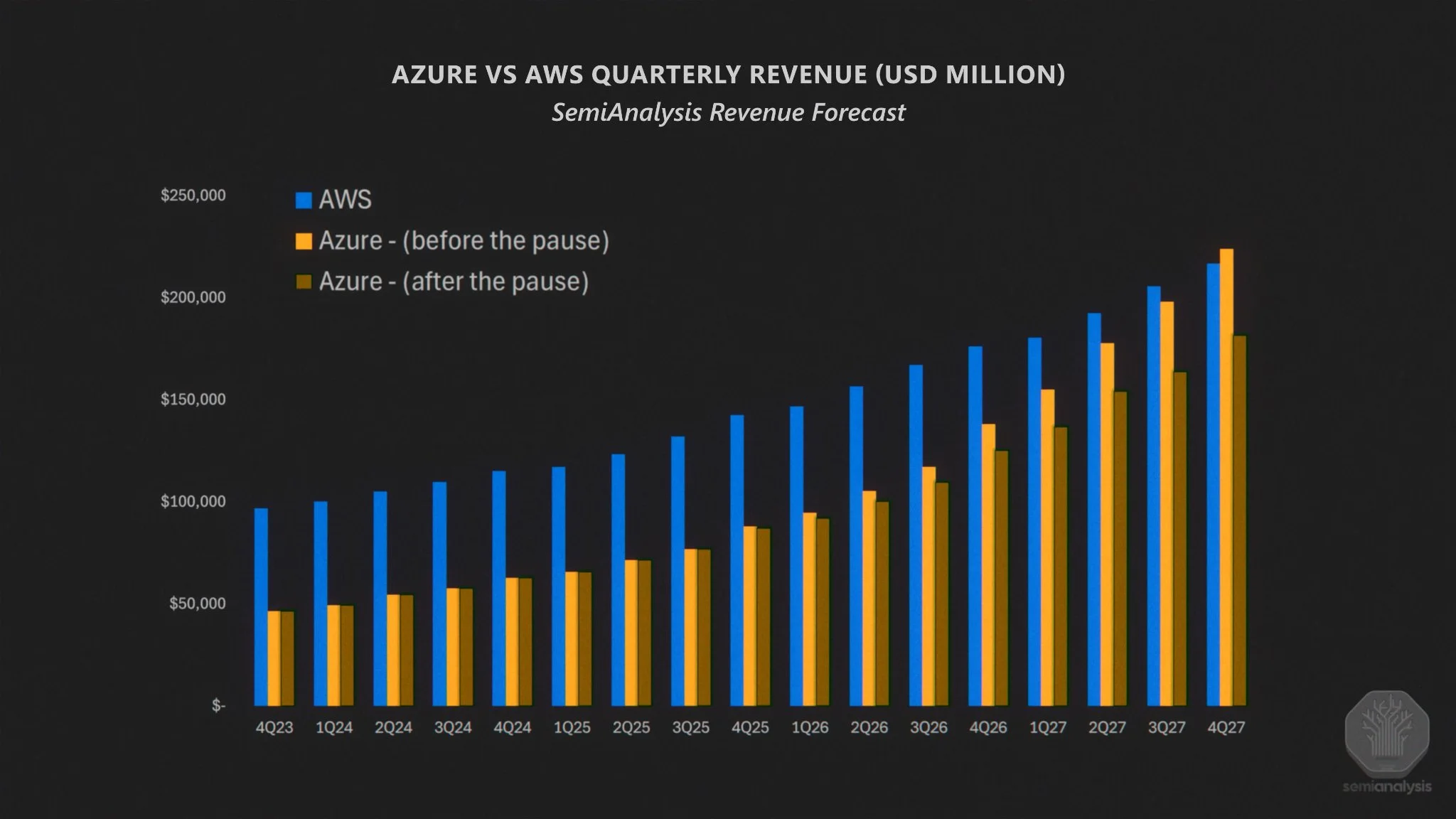
Dylan Patel: So last year Microsoft was on path to be the largest infrastructure provider by far. You were the earliest in 2023, so you went out there, you acquired all the resources in terms of leasing data centers, starting construction, securing power, everything. You guys were on pace to beat Amazon in 2026 or 2027. Certainly by 2028 you were going to beat them.
Since then, let’s call it, in the second half of last year, Microsoft did this big pause, where they let go of a bunch of leasing sites that they were going to take, which then Google, Meta, Amazon in some cases, Oracle, took these sites.
We’re sitting in one of the largest data centers in the world, so obviously it’s not everything, you guys are expanding like crazy. But there are sites that you just stopped working on. Why did you do this?
Satya Nadella: This goes back a little bit to, what is the hyperscale business all about? One of the key decisions we made was that if we’re going to build out Azure to be fantastic for all stages of AI—from training to mid-training to data gen to inference—we just need fungibility of the fleet. So that entire thing caused us basically not to go build a whole lot of capacity with a particular set of generations.
Because the other thing you have to realize is that having up to now 10x’ed every 18 months enough training capacity for the various OpenAI models, we realized that the key is to stay on that path. But the more important thing is to have a balance, to not just train, but to be able to serve these models all around the world. Because at the end of the day, the rate of monetization is what will then allow us to keep funding. And then the infrastructure was going to need us to support multiple models.
So once we said that that’s the case, we just course-corrected to the path we’re on. If I look at the path we’re on, we are doing a lot more starts now. We are also buying up as much managed capacity as we can, whether it’s to build, whether it’s to lease, or even GPUs as a service. But we’re building it for where we see the demand and the serving needs and our training needs. We didn’t want to just be a hoster for one company and have just a massive book of business with one customer. That’s not a business, you should be vertically integrated with that company.
Given that OpenAI was going to be a successful independent company, which is fantastic. It makes sense. And even Meta may use third-party capacity, but ultimately they’re all going to be first-party. For anyone who has large scale, they’ll be a hyperscaler on their own. To me, it was to build out a hyperscale fleet and our own research compute. That’s what the adjustment was. So I feel very, very good.
By the way, the other thing is that I didn’t want to get stuck with massive scale of one generation. We just saw the GB200s, the GB300s are coming. By the time I get to Vera Rubin, Vera Rubin Ultra, the data center is going to look very different because the power per rack, power per row, is going to be so different. The cooling requirements are going to be so different. That means I don’t want to just go build out a whole number of gigawatts that are only for a one-generation, one family. So I think the pacing matters, the fungibility and the location matters, the workload diversity matters, customer diversity matters and that’s what we’re building towards.
The other thing that we’ve learned a lot is that every AI workload does require not only the AI accelerator, but it requires a whole lot of other things. In fact, a lot of the margin structure for us will be in those other things. Therefore, we want to build out Azure as being fantastic for the long tail of the workloads, because that’s the hyperscale business, while knowing that we’ve got to be super competitive starting with the bare-metal for the highest end training.
But that can’t crowd out the rest of the business, because we’re not in the business of just doing five contracts with five customers being their bare-metal service. That’s not a Microsoft business. That may be a business for someone else, and that’s a good thing. What we have said is that we’re in the hyperscale business, which is at the end of the day a long tail business for AI workloads. And in order to do that, we will have some leading bare-metal-as-a-service capabilities for a set of models, including our own. And that, I think, is the balance you see.
This was well played by Dylan and benefits from his mental model around compute capacity. Essentially, the Microsoft leadership team decided to slow down building out additional data centers for accelerated computing, which will constrain their ability to capture potential demand that could have allowed them to pull ahead of AWS. Satya's argument was that it was a fair decision, since it would allow Azure to be better positioned over a ten year horizon than to win one, albeit important, achievement in the short term.
Source: SemiAnalysis
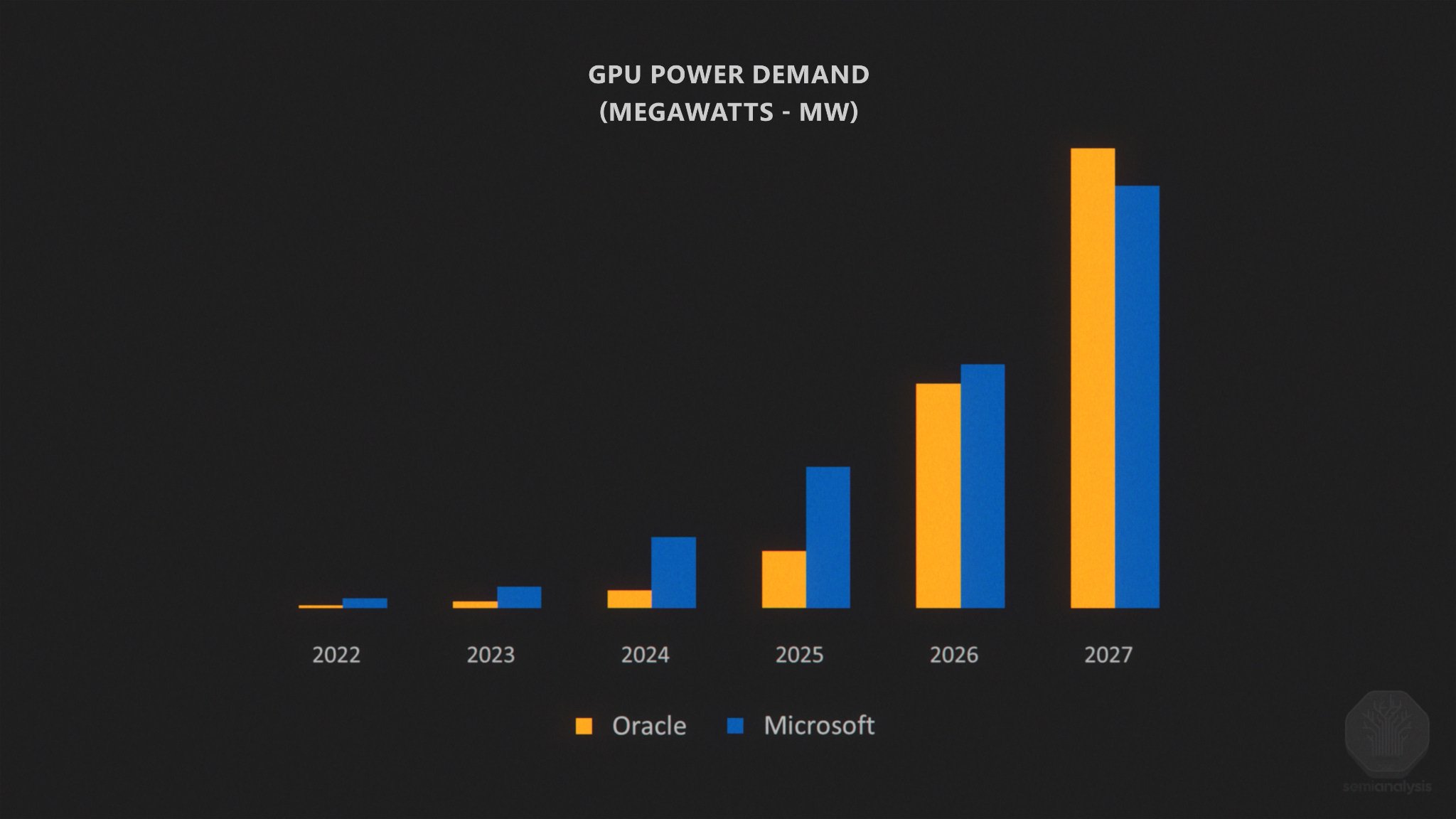
Dylan Patel: Prior to the pause, what we had forecasted for you, by 2028 you were going to be 12–13 gigawatts. Now we’re at nine and a half or so.
But something that’s even more relevant—and I just want you to more concretely state that this is the business you don’t want to be in—is that Oracle’s going from 1/5th your size to bigger than you by the end of 2027.
While it’s not a Microsoft-level quality of return on invested capital, they’re still making 35% gross margins. So the question is, maybe it’s not Microsoft’s business to do this, but you’ve created a hyperscaler now by refusing this business, by giving away the right of first refusal, et cetera.
Satya Nadella: First of all, I don’t want to take away anything from the success Oracle has had in building their business and I wish them well. The thing that I think I’ve answered for you is that it didn’t make sense for us to go be a hoster for one model company with limited time horizon RPO. Let’s just put it that way.
The thing that you have to think through is not what you do in the next five years, but what you do for the next 50. We made our set of decisions. I feel very good about our OpenAI partnership and what we’re doing. We have a decent book of business. We wish them a lot of success. In fact, we are buyers of Oracle capacity. We wish them success.
But at this point, I think the industrial logic for what we are trying to do is pretty clear, which is that it’s not about chasing… First of all, I track, by the way, your things whether it’s AWS or Google and ours, which I think is super useful. But it doesn’t mean I have to chase those. I have to chase them for not just the gross margin that they may represent in a period of time. What is this book of business that Microsoft uniquely can go clear, which makes sense for us to clear? That’s what we’ll do.
The key defense from Microsoft here is that they see a big difference between "high quality" utilization of their gigawatt capacity and didn't see the point of sitting on a risky asset tied to the success of one player who only wants bare metal access. The alternative view is that Satya flinched.
Dylan Patel: There are sort of two questions here. One is, why couldn’t you just do both? The other one is, given our estimates on what your capacity is in 2028, it’s three and a half gigawatts lower. Sure, you could have dedicated that to OpenAI training and inference capacity, but you could have also dedicated that to actually just running Azure, running Microsoft 365, running GitHub Copilot. I could have just built it and not given it to OpenAI.
Satya Nadella: Or I may want to build it in a different location. I may want to build it in the UAE, I may want to build it in India, I may want to build it in Europe. One of the things is, as I said, where we have real capacity constraints right now, given the regulatory needs and the data sovereignty needs, we’ve got to build all over the world. First of all, stateside capacity is super important, and we want to build everything.
But when I look out to 2030, I have a global view of what is Microsoft’s shape of business by first-party and third-party. Third-party segmented by the frontier labs and how much they want versus the inference capacity we want to build for multiple models, and our own research compute needs. That’s all going into my calculus. You’re rightfully pointing out the pause, but the pause was not done because we said, “Oh my God, we don’t want to build that.” We realized that we want to build what we want to build slightly differently by both workload type as well as geo-type and timing as well.
We’ll keep ramping up our gigawatts, and the question is at what pace and in what location. And how do I ride Moore’s law on it, which is, do I really want to overbuild three and a half in 2027 or do I want to spread that in 2027-28 knowing even… One of the biggest learnings we had even with Nvidia is that their pace increased in terms of their migrations.
That was a big factor. I didn’t want to go get stuck for four or five years of depreciation on one generation. In fact, Jensen’s advice to me was two things. One is, get on the speed-of-light execution. That’s why the execution in this Atlanta data center.... I mean, it’s like 90 days between when we get it and to hand off to a real workload. That’s real speed-of-light execution on that front. I wanted to get good on that.
And then that way I’m building each generation in scaling. And then every five years, you have something much more balanced. So it becomes literally like a flow for a large-scale industrial operation like this where you’re suddenly not lopsided, where you’ve built up a lot in one time and then you take a massive hiatus because you’re stuck with all this, to your point, in one location which may be great for training, or it may not be great for inference because I can’t serve, even if it’s all asynchronous, because Europe won’t let me round-trip to Texas. So that’s all of the things.
Dylan Patel: How do I rationalize this statement with what you’ve done over the last few weeks? You’ve announced deals with Iris Energy, with Nebius, and Lambda Labs, and there’s a few more coming as well. You’re going out there and securing capacity that you’re renting from the neoclouds rather than having built it yourself.
Satya Nadella: It’s fine for us because now when you have line of sight to demand, which can be served where people are building, it’s great. In fact we will take leases, we will take build-to-suit, we’ll even take GPUs-as-a-service where we don’t have capacity but we need capacity and someone else has that.
And by the way, I would even sort of welcome every neocloud to just be part of our marketplace. Because guess what? If they go bring their capacity into our marketplace, that customer who comes through Azure will use the neocloud, which is a great win for them, and will use compute, storage, databases, all the rest from Azure. So I’m not at all thinking of this as, “Hey, I should just go gobble up all of that myself.”
This brings up an interesting variable in that decision: the choice to compete in other traditional markets for Microsoft and the preference to reserve capital to build out in those regions with greater efficiency. A sensible business decision, but still limiting their short term growth potential. The other side of the equation, of course, is that Microsoft might not want to be on the receiving end of antitrust litigation ever again.
Dylan Patel: Other hyperscalers are taking loans. Meta has done a $20 billion loan at Louisiana. They’ve done a corporate loan. It seems clear everyone’s free cash flow is going to zero, which I’m sure Amy is going to beat you up if you even try to do that, but what’s happening?
Satya Nadella: I think the structural change is what you’re referencing, which is massive. I describe it as we are now a capital-intensive business and a knowledge-intensive business. In fact, we have to use our knowledge to increase the ROIC on the capital spend.
The hardware guys have done a great job of marketing Moore’s Law, which I think is unbelievable and it’s great. But if you even look at some of the stats I even did in my earnings call, for a given GPT family, the software improvements of really throughput in terms of tokens-per-dollar-per-watt that we’re able to get quarter-over-quarter, year-over-year, it’s massive. It’s 5x, 10x, maybe 40x in some of these cases, just because of how you can optimize. That’s knowledge intensity coming to bring out capital efficiency. That, at some level, is what we have to master.
Some people ask me, what is the difference between a classic old-time hoster and a hyperscaler? Software. Yes, it is capital intensive, but as long as you have systems know-how, software capability to optimize by workload, by fleet... That’s why when we say fungibility, there’s so much software in it. It’s not just about the fleet.
It’s the ability to evict a workload and then schedule another workload. Can I manage that algorithm of scheduling around? That is the type of stuff that we have to be world-class at. So yes, I think we’ll still remain a software company, but yes, this is a different business and we’re going to manage. At the end of the day, the cash flow that Microsoft has allows us to have both these arms firing well.
It's called cloud infrastructure software, not bare metal hosting shops. The point of the business is the combination of hardware and software being utilized to deliver business outcomes through the most common way that companies today consume software: the cloud.
Dwarkesh Patel: Do you buy… These labs are now projecting revenues of $100 billion in 2027–28 and they’re projecting revenue to keep growing at this rate of 3x, 2x a year…
Satya Nadella: In the marketplace there’s all kinds of incentives right now, and rightfully so. What do you expect an independent lab that is sort of trying to raise money to do? They have to put some numbers out there such that they can actually go raise money so that they can pay their bills for compute and what have you.
And it’s a good thing. Someone’s going to take some risk and put it in there, and they’ve shown traction. It’s not like it’s all risk without seeing the fact that they’ve been performing, whether it’s OpenAI, or whether it’s Anthropic. So I feel great about what they’ve done, and we have a massive book of business with these chaps. So therefore that’s all good.
But overall ultimately, there’s two simple things. One is you have to allocate for R&D. You brought up talent. The talent for AI is at a premium. You have to spend there. You’ve got to spend on compute. So in some sense researcher-to-GPU ratios have to be high. That is sort of what it takes to be a leading R&D company in this world. And that’s something that needs to scale, and you have to have a balance sheet that allows you to scale that long before it’s conventional wisdom and so on. That’s kind of one thing. But the other is all about knowing how to forecast.
There is a lot of fear right now in the industry around the "AI bubble," mostly driven by disbelief about whether OpenAI will actually deliver on the unprecedented growth it claims it will achieve. Satya has decided to hedge his bet: still fund part of the buildout required if OpenAI scales well, but limit liability if they underperform. Others, such as Larry at Oracle, have taken significant risks in an attempt to capture higher returns if OpenAI succeeds.
At a time when most forecast AGI on a ten year horizon, Satya has made the prudent choice. In a scenario where he is wrong and OpenAI shifts the table stakes again, he remains well positioned to drive the business forward.
While it's easy to see this as risk avoidance, the difference between amateurs and professionals is mostly about who can maintain clear thinking when things start to get shaky.
